Murlidhar Infrastructure builds internal factory roads, approach roads, solar site access tracks and rural connectivity roads, engineered to the load and traffic requirements of the site rather than a generic specification. From sub-grade preparation to final wearing course, every layer is compacted and tested before the next is laid.
Road failure almost always traces back to inadequate sub-grade preparation or skipped compaction testing, not the wearing surface. We start every road project with a soil investigation to determine sub-grade strength (CBR), then design the pavement layer thicknesses - sub-base, base course and surface - specifically for the axle loads your site will carry, whether that's daily truck traffic to a factory or occasional heavy-equipment movement to a solar site.
Depending on your budget and traffic requirement, we construct water-bound macadam (WBM), wet mix macadam (WMM), bituminous roads, or plain cement concrete (PCC) roads, each compacted in layers and tested for density before proceeding to the next stage.
For solar and industrial sites, we also build access tracks designed for heavy crane and transformer movement during construction, engineered with adequate turning radii and load capacity that standard rural roads are not built to handle.
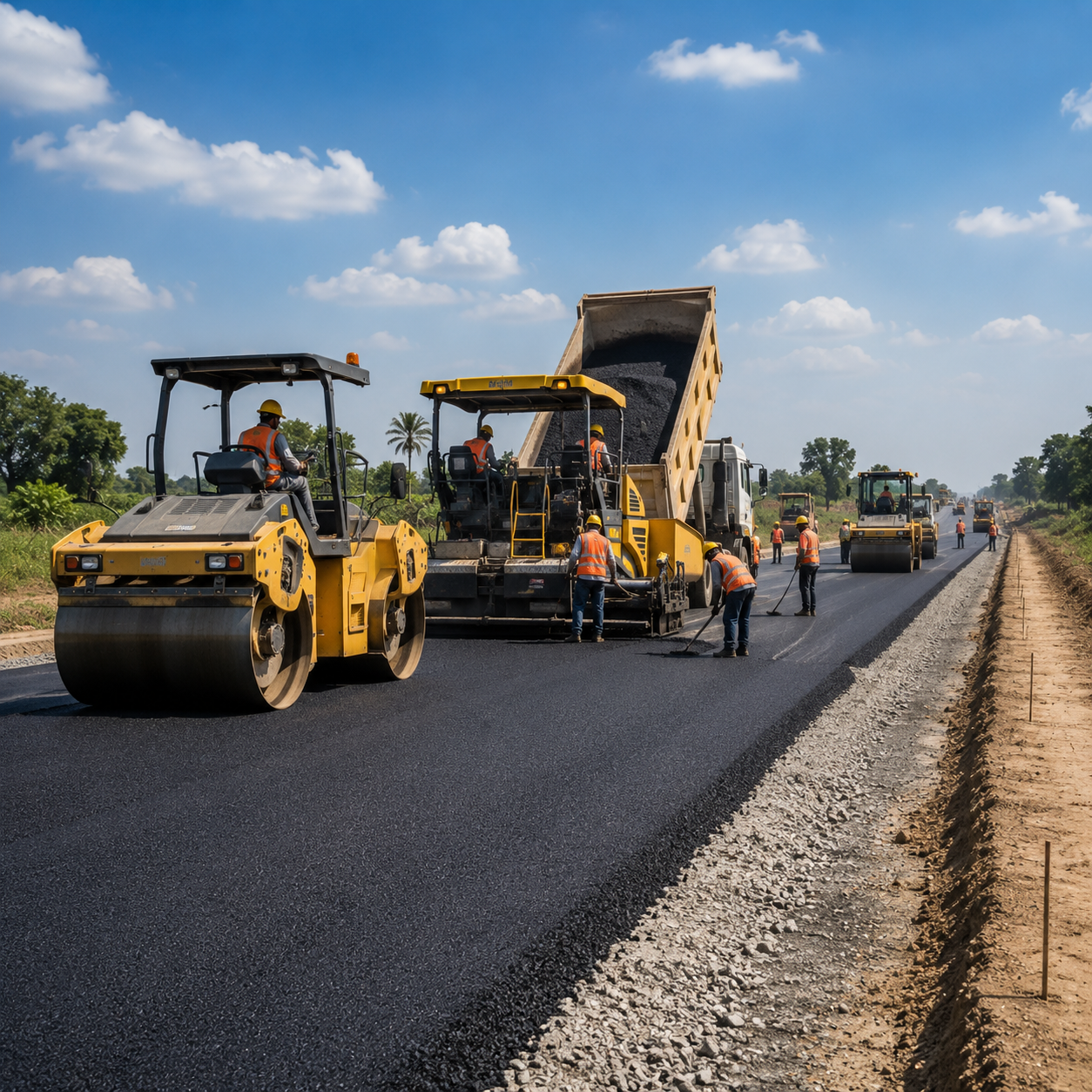
Four reasons clients trust us with projects that can't afford delays or shortcuts.
Sub-grade CBR testing determines layer thickness, so your road is engineered for actual load conditions, not guesswork.
Every pavement layer is compacted and density-tested before the next is laid, preventing premature road failure.
WBM, WMM, bituminous and PCC road construction available to match your budget and traffic load.
We design access tracks specifically for crane, transformer and heavy-vehicle movement at industrial and solar sites.
We test sub-grade soil strength and survey the road alignment, gradient and drainage requirements.
Layer thickness for sub-base, base and surface course is calculated based on expected traffic load.
Each pavement layer is laid, graded and compacted with density testing before the next layer proceeds.
The wearing course is finished and side drainage is constructed to prevent water accumulation.
Get a transparent, itemised quotation after a quick site assessment.